
Faculty Spotlight: Josh Ehrlich
June 15, 2026
Advancing Global Aging and Sensory Health Research
Josh Ehrlich‘s interest in population health came long before medical and public health school. His undergraduate education was in anthropology which fundamentally challenged his views on issues like illness and well-being. Where he previously assumed these constructs had universal meaning, he came to understand that they are heavily shaped by culture, language, and politics.
Ehrlich brought this heterodox perspective with him to medical school, which influenced his decision to take time off to study public health; epidemiology in particular, was great methodological training and introduced him to rigorous quantitative inquiry.
Back at medical school, Dr. Ehrlich recognized that blindness and vision loss is a massive yet solvable public health issue and brought together the clinical, epidemiological, and social pieces of the puzzle.
His transition to global aging research was a fairly natural turn: two large demographic groups, those living in low- and middle-income countries and older adults, are by far the most affected by blindness and vision loss and it was natural that Dr. Ehrlich’s focus gravitated to where his work could make the most difference. Eventually he found that epidemiology alone didn’t answer the questions he was interested in; now many of his closest collaborators include demographers, economists, and sociologists.
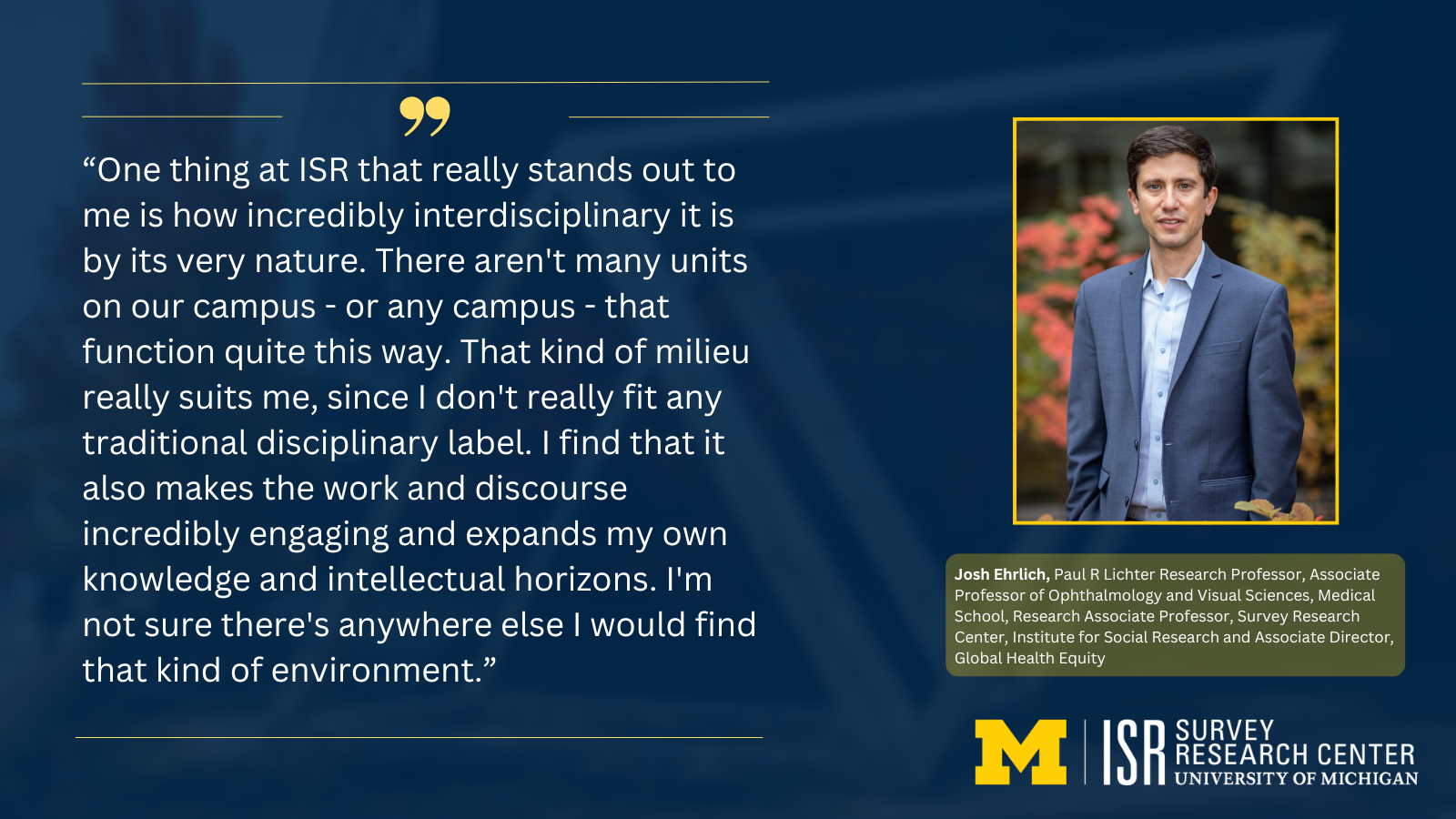
“One thing at ISR that really stands out to me is how incredibly interdisciplinary it is by its very nature. There aren’t many units on our campus – or any campus – that function quite this way. That kind of milieu really suits me, since I don’t really fit any traditional disciplinary label. I find that it also makes the work and discourse incredibly engaging and expands my own knowledge and intellectual horizons. I’m not sure there’s anywhere else I would find that kind of environment.”
Current research
Dr. Ehrlich’s current research is focused on two complementary areas. The first is global population aging. He co-leads the Longitudinal Study of Health and Ageing in Kenya (LOSHAK) along with his colleague Anthony Ngugi at Aga Khan University in Nairobi. This study belongs to the HRS Around the World and HCAP Networks and is collecting population representative data in older Kenyan adults on varied dimensions of health and economic well-being. The study is quite unique in that region of the world and has incredible potential to transform how we understand aging and longevity, as well as to shape public health and economic policy.
The second area of research Dr. Ehrlich concentrates on is later-life sensory health (vision, hearing, etc.). Sensory loss illuminates many of the health and economic challenges and inequities present in aging societies and because so many sensory losses are correctable or preventable, this research can also be a lever to improve aging outcomes and promote economic development.
Along with his primary research, Dr. Ehrlich leads initiatives like SENSE Network (along with colleague Jennifer Deal at Johns Hopkins) and the Michigan Sensory Health and Aging Research Collaborative (Mi-SHARC) that aim to grow the field of sensory aging research, promote interdisciplinary collaboration, and train the next generation researchers.
These two prongs of Ehrlich’s research are a natural fit and as his research evolves, he hopes to see even greater synergy between them.
Longitudinal Study of Health and Ageing in Kenya (LOSHAK)
LOSHAK has become a career defining project for Dr. Ehrlich. Due to previous work in Kenya and the prominence of global aging in his research, Ehrlich was involved in early conversations between the Center for Global Health Equity (CGHE) at the University of Michigan and Aga Khan University (AKU) in Nairobi.
Researchers at AKU recognized early on that population aging – a particular strength at University of Michigan’ Institute for Social Research – was an area where they wanted to build capacity. The Kenyan population is currently very young, but the 60+ cohort is expected to quadruple in 30 years.
Dr. Ehrlich and Anthony Ngugi connected during these discussions and early seed funding from CGHE and National Institute of Health showed how well the large interdisciplinary and transnational teams worked together. In 2025, NIH awarded the team a $23.6 million grant to field the first wave of full national HRS-style and regional HCAP studies. The teams have grown quite a lot. Their partnerships with other academic partners, as well with the Kenya Ministry of Health and Kenya National Bureau of Statistics are essential for building trust, engaging communities, and ensuring that the work we do has a positive impact on public health, economic policy, and preparedness for the impending demographic transition in Kenya.
Watch Josh Ehrlich discuss LOSHAK in the ISR Insights Series.