
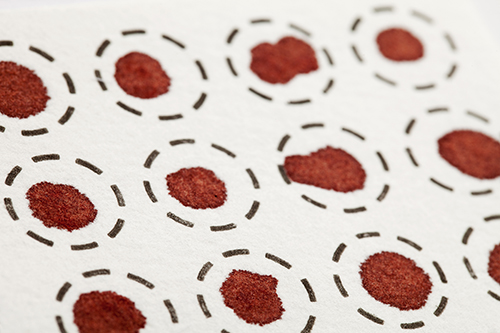
SRC research Jessica Faul and collaborators recently published an analysis showing how factors related to collection, storage, transport time, and environmental conditions affect the quality and accuracy of analyses of dried blood spot samples. The group published their findings in the American Journal of Human Biology – The associated journal of the American Biology Association.
Dried blood spots are a popular method used in large studies to collect biomarker information. Blood spots are an alternative to traditional and more invasive venous blood collection. Respondents are more likely to participate and the dried blood spots themselves have minimal requirements for transportation and storage, and reduced biohazard risks. Despite many advantages of using dried blood spots in data collection, issues that arise in the pre-analytic phase may have substantial influences in the validity of dried blood spot assays compared to the venous blood draw. These influences may include lower analyte yield, stability of the sample, and the promotion of bacterial growth, which in turn may degrades blood samples. This study aims to identify factors related to collection, storage, transport, and environmental conditions that affect the quality of dried blood spot samples and to promote protocols that produce accurate values.
Faul and colleagues assessed differences in total cholesterol, high-density lipoprotein (HDL) cholesterol, glycosylated hemoglobin A1c (HbA1c), glucose, C-reactive protein (CRP), and cystatin C between dried blood spot and venous blood sample. The investigators merged their collection data on the blood spots with temperature and humidity data from the National Climatic Data Center Global Historical Climate Network Daily by zip code. Environmental and blood spot properties investigated include: quality of the dried blood spot card (multiple drops, smeared drops, overlapping spots, incorrectly placed desiccant), quality of individual spots (overlapping/smeared spot, small spot), days before freezing (3, 4-5, 6-7, 8+ days), high humidity, high temperature, with and without adjustment for venous blood sample.
In general, cystatin C, HbA1c, and CRP were generally resilient to many of the environmental and blood spot property measures. Total cholesterol measures were sensitive to smeared blood drops, small spots, high humidity, high temperature and the number of days before freezing. Days before freezing, high humidity, and high temperature strongly influenced the HDL measures downward. Across the five blood measures, having a small blood spot was associated with a lower blood measure.
The authors conclude that the effect of shipping, collection, and environmental factors vary by analyte with cholesterol measures being sensitive to multiple influences. In general, when an analyte is affected, the measurement is reduced by adverse conditions. In addition, the size of the blood spot has an effect on multiple analytes and care should be taken to avoid small spots. If this cannot be avoided, small sample spots should be noted and coded so that adjustment can be made in future analyses.
This important investigation has a broad impact on studies wishing to add biomarker data to their data collection protocols. The study emphasizes the importance of documenting information on the quality of dried blood spots as well as shipping time and conditions. Like much of the sampling and survey biases we explore in social science, biological data is also prone to collection and environmental influences. This intersection of biological and social science methodology is an important nexus where we can all learn from each other’s methods to better investigate population health.
Eileen M. Crimmins, Yuan S. Zhang, Jung Ki Kim, Stephen Frochen, Hyewon Kang, Hyunju Shim, Jennifer Ailshire, Alan Potter, Jake Cofferen, and Jessica Faul (2020). Dried blood spots: Effects of less than optimal collection, shipping time, heat, and humidity. American Journal of Human Biology.

Tobacco and alcohol use are two critical risk factors for many health conditions, and important causes for mortality. In a new article published in Nature Genetics, SRC scientists Jessica Faul, Jennifer Smith, and David Weir in collaboration with a large team of researchers present innovative research examining the genetic etiology of tobacco and alcohol use based on data from up to 1.2 million individuals. This important research reflects a recent endeavor in bridging social science research with genome wide association studies (GWAS).
Variants in the human genome contribute to human phenotypes (traits and diseases). With the development of genotyping technology, GWAS has been widely used in biomedical research aiming to find the genetic basis of human phenotype differences. With the power of SNP microarrays, study samples of thousands of people can reveal aspects of the genetic basis of human disease. To date, GWAS have revealed risk loci associated with important diseases such as Alzheimer’s, Parkinson’s, multiple types of cancer, and many other traits and diseases. With the advance of next generation sequencing, GWAS studies will be boosted to the next level with better designs to target different ethnicities within the population. In addition, the size of available genetic data has been increased exponentially with the establishment of national-level biological sample databanks like UK Biobank, Iceland’s deCODE genetics, and the genetic data now available for nationally-representative surveys including the National Longitudinal Study of Adolescent to Adult Health (Add Health) and the Health and Retirement Study (HRS), both included in the Nature Genetics article. This massive amount of genetic data allows researchers to seek the association between genetic variations and traits that were not necessarily considered to have strong genetic components. With this available population-based data, researchers are turning to investigation of the genetic relationship to respondents’ risk behaviors and the early development of diseases.
This particular study by these three SRC colleagues and their collaborators evaluated genetic data from multiple studies and biobanks, amounting to over 1.2 million individuals. They performed state-of-the-art genetic analysis and meta-analysis to examine the etiology of tobacco and alcohol use. With such big data, over 400 loci associated with the tobacco use and alcohol consumption were identified; a majority of these were previously unknown to have associations with these traits. Identifying these genetic risk factors allows for the potential to better estimate a person’s risk for substance addiction using genetic information. It also shows that social science data and methodologies can be effectively intergrated with the population level GWAS method to identify new genetic risk loci. Life history may influence the penetrance of addiction associated risk alleles, and combining survey methodology with genetic data will help to identify these alleles. This will provide better prevention for addiction and promote the overall social welfare.
Liu, Mengzhen;…Faul, Jessica D.; …Smith, Jennifer A.; … Weir, David R.;…(2019). Association studies of up to 1.2 million individuals yield new insights into the genetic etiology of tobacco and alcohol use. Nature genetics.
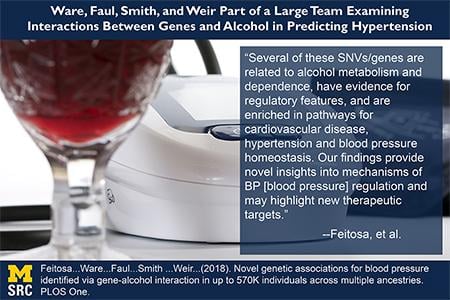
SRC Scientists Erin B. Ware, Jessica Faul, Jennifer Smith, and David Weir recently collaborated with a large team of researchers that collectively make up the CHARGE Gene-Lifestyle Interactions Working Group to publish a novel analysis of the interactions between specific genes and alcohol consumption when predicting hypertension. Their study was published in the widely read interdisciplinary journal PLoS ONE, and since the article was published in June 2018, it has been viewed online more than 830 times, underscoring the importance of this work. Hypertension is a critical public health problem worldwide and understanding the biological mechanisms that could explain it, especially as they relate to alcohol consumption, is essential for improving the human condition.
These four SRC colleagues and their collaborators are doing truly innovative biosocial research, and this article is a prime example of the fascinating knowledge that this blossoming field is producing. As the authors note, it is unclear how alcohol consumption currently affects blood pressure regularization, and they sought to investigate whether consumption would interact with certain genes to effectively predict blood pressure outcomes.
The research team performed a state-of-the-art genetic analysis that featured two stages. In the first stage, they performed genome-wide discovery meta-analyses of nearly 131,000 individuals from a variety of ancestries, primarily to identify single nucleotide variants (SNVs) that were associated with blood pressure for individuals with different drinking status (e.g., current drinkers). The team found more than 3,500 SNVs that had significant associations with blood pressure outcomes (after adjusting for the large number of tests performed), and the associations did vary based on drinking status. They then sought to replicate these findings in a second stage, analyzing more than 440,000 individuals (again across a variety of ancestries) and finding those SNVs (out of the more than 3,500 identified in the first stage) that were once again significantly associated with blood pressure. In all their analyses, they studied variations in the associations depending on alcohol consumption status, and they ultimately reported novel associations of selected genes with blood pressure outcomes in addition to replications of prior work.
In the end, the authors were able to find novel loci of genes that were found to have strong associations with blood pressure outcomes for different subgroups defined by drinking status, representing the main contribution of this massive study. Interestingly, the authors report that the novel loci were different depending on ancestry. The authors conclude by noting that ‘Several of these SNVs/genes are related to alcohol metabolism and dependence, have evidence for regulatory features, and are enriched in pathways for cardiovascular disease, hypertension and blood pressure homeostasis. Our findings provide novel insights into mechanisms of BP [blood pressure] regulation and may highlight new therapeutic targets.’ I really appreciated this concluding emphasis on potential targets for therapy; wouldn’t it be wonderful if innovative studies like this could ultimately lead to simultaneous improvements in blood pressure and alcohol dependence?
Mary F. Feitosa…Erin B. Ware…Jessica Faul…Jennifer A. Smith …David Weir…(2018). Novel genetic associations for blood pressure identified via gene-alcohol interaction in up to 570K individuals across multiple ancestries. PLOS One.