
Faculty Spotlight: Reed DeAngelis
October 7, 2026
A Musician’s Guide to Population Health
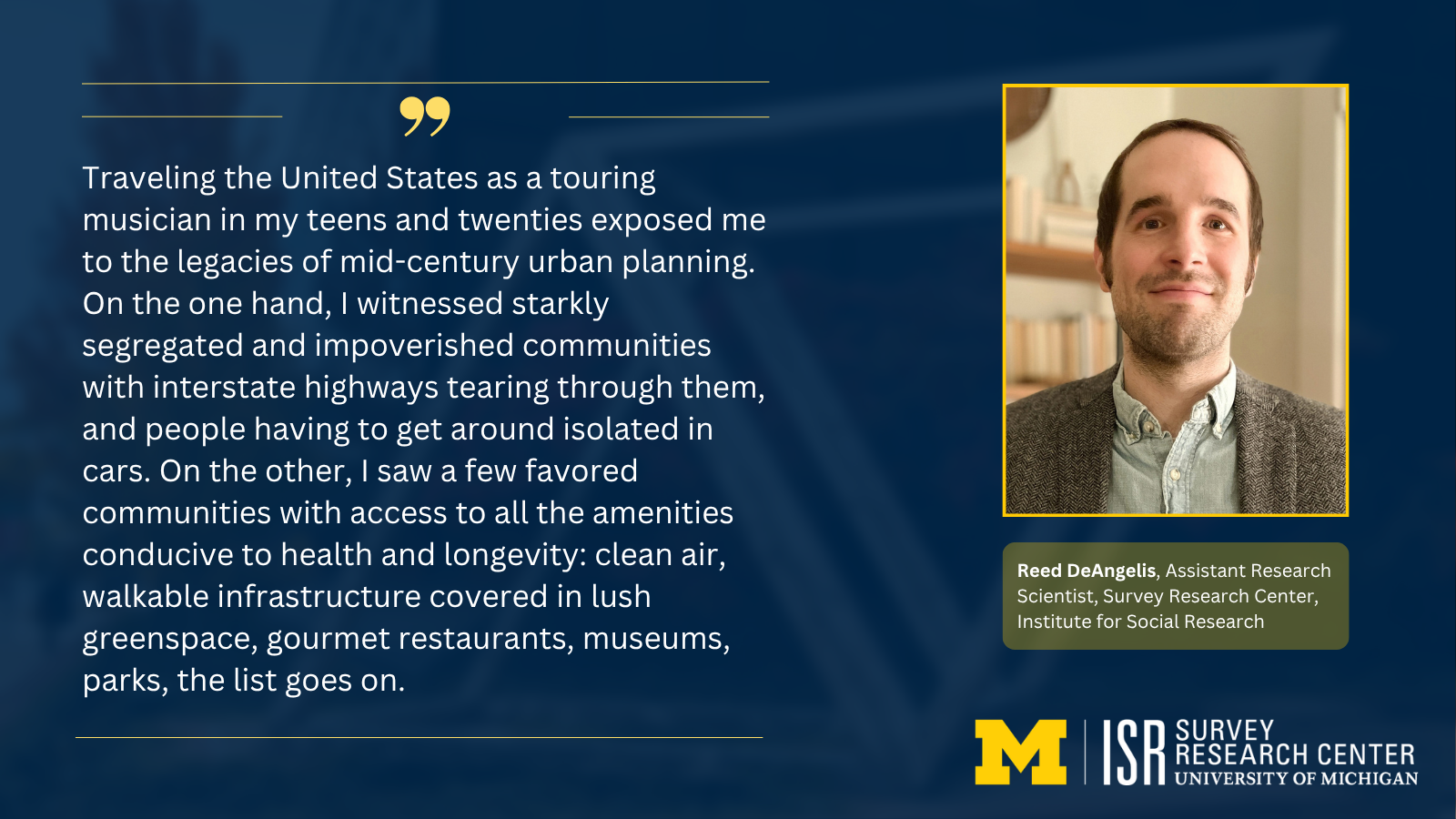
Touring the United States as a musician in his teens and twenties exposed Reed DeAngelis to the lasting effects of mid-century urban planning. He witnessed segregated, impoverished neighborhoods divided by interstate highways, alongside favored communities offering conditions that support health and longevity: clean air, walkable streets, green space, restaurants, museums, and parks.
These experiences revealed how far the United States remains from realizing its potential. DeAngelis returned to school to study health disparities and show how inequitable conditions make people sick, weaken democracy, and waste money.
What Makes Us Healthy?
While population health scientists often focus on illness and inequity, DeAngelis also studies what helps people thrive. One area of his research examines how different dimensions of religion and spirituality can improve or harm health. The relationship is complex, and more work is needed to identify which aspects are beneficial. He also hopes to explore the health effects of music and other soundscapes, including natural and urban sounds.
Landscapes of Population Health
Researchers in DeAngelis’ home program, Landscapes of Population Health, investigate the “on-the-ground” conditions that promote or undermine health. Because these conditions vary across place and time, the team develops tools, datasets, measurements, and methods to identify environments that support population health and longevity.
Continuing Education
A musician by nature, DeAngelis began learning through music and philosophy—from Bukka White and XTC to Bad Brains and the Beatles—as well as Montaigne’s Complete Essays. Today, his education continues through gardening, playing music, and cooking with his wife, Allison. He is also fascinated by the board game, Go, which he started learning on a few apps while a postdoc; he finds it disturbing that humans can’t seem to beat AI at Go anymore.