
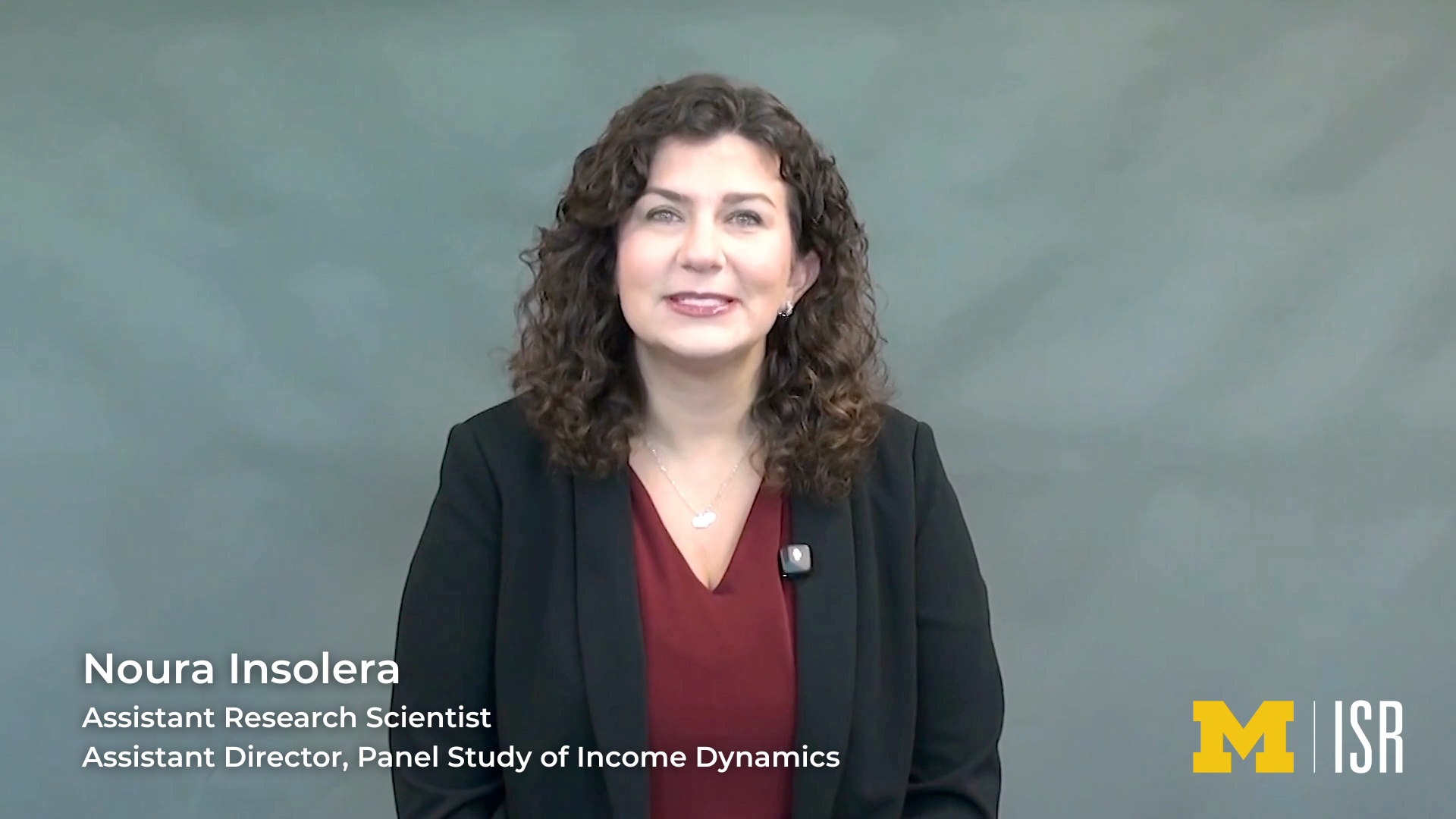
Real world impact of ISR research: Noura Insolera
November 17, 2025
In this video, Noura Insolera, assistant research scientist at ISR and the assistant director of the Panel Study of Income Dynamics (PSID), discusses how families move into and out of food insecurity over time, and longitudinal data from the PSID allows researchers to see how these shifts occur.
Something I think that most people may not know is that things like food insecurity don’t just impact families that are in poverty. There are many families that are moving into and out of food insecurity over time, and so by looking at people over time, the same families from year to year, we’re able to see these changes.
We’re able to look at the families who remain food insecure, those who get out, and those who fall into it, and we can look at the things that impact their lives that are maybe changing these things for the better or for the worse.
I’m an assistant research scientist here at ISR. I’m also the assistant director of the Panel Study of Income Dynamics, or the PSID. Working with the PSID, I am in touch with a lot of our data users over time, and I see how rich, complex, longitudinal data is really the only place where we can study a lot of these topics.
For me personally, in my own academic pursuits, I’m able to follow people over their life course from childhood through adulthood. I’m able to look at these different compositions: those with children, families with elderly individuals, and everything in between.
My research can help to inform policy in a few ways. One, by looking at families over time, we’re able to see the different inflection points and where families might need intervention. By looking at cross-sections or one point in time, we’re able to see sort of a snapshot of the United States, but not necessarily how things are getting better or worse. From a policy perspective, it might be really important to know when families start to worry about food insecurity and not wait to help them until they’re in dire straits.
From my perspective, it would be impossible to get another PSID today. We’ve been around for over 57 years, collecting data on the same families, generation after generation, year after year. And so it’s a really unique place to be able to look at these complex questions and actually tease out the mechanisms behind the problems that we’re seeing or the successes that we’re able to capture.
We’ve shown time and time again that across the entire nation, public safety net programs help families, individuals, those with children, families with elderly individuals across the life course and year after year.
For more research on food insecurity, read about “New and Recurring Food Insecurity During and After the COVID-19 Pandemic.”