

Survey finds strong sustainability commitment across U-M
December 11, 2025
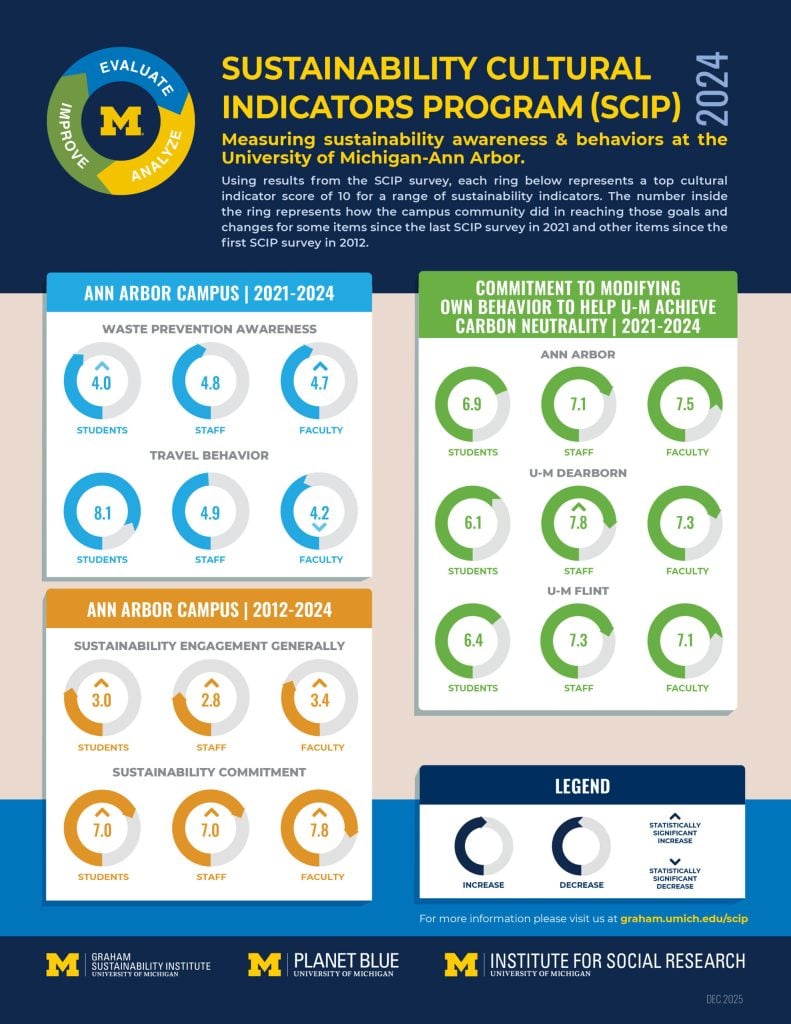
The University of Michigan community is showing strong personal commitment to sustainability, according to 2024 Sustainability Cultural Indicators Program, or SCIP, data.
Across the Ann Arbor, Dearborn and Flint campuses, students, faculty and staff report widespread engagement with sustainable behaviors, awareness of climate issues, and belief in their ability to make a difference.
Climate change is widely recognized as real and urgent, and students demonstrate solid understanding of climate and sustainability topics. At the same time, the survey points to areas where more work is needed, including transportation choices, and awareness of university sustainability programs.
“SCIP helps us see where our community is most engaged and where there are opportunities to do more,” said John Callewaert, co-principal investigator. “It shows not only the behaviors and attitudes that are taking hold, but also the areas where we can better support meaningful action.”
Nearly 6,000 members of the U-M community participated in the 2024 survey. Participation was strong across all campuses: Over 3,000 students and more than 2,000 faculty and staff responded in Ann Arbor, with similarly robust engagement relative to campus size at Dearborn and Flint.
SCIP continues to expand through collaboration with other universities. Since 2024, U-M has partnered with Rutgers University, which has adapted the SCIP model for its own sustainability and climate-action initiatives. The partnership allows both universities to compare trends, explore shared challenges, and strengthen insights through a larger dataset.
U-M’s research team is also consulting with other institutions interested in applying similar long-term approaches to studying sustainability culture.
“Collecting this kind of long-term data is rare, and it’s incredibly valuable,” said Robert Marans, co-principal investigator. “SCIP gives us a clear picture of how sustainability culture evolves over time, and it’s why other universities are looking to Michigan as a model for understanding and supporting their own communities.”
SCIP data is also being used as part of a new sustainability undergraduate course developed and taught by Noah Webster, co-principal investigator, as part of U-M’s Program in the Environment.
“A key part of the course is the opportunity for students to work with SCIP data to evaluate sustainability initiatives and programs, as well as to address innovative research questions that can help catalyze further cultural change,” said Webster, who is also a research associate professor in the Institute for Social Research’s Survey Research Center.
Sustainability leaders across the University of Michigan, who form the university’s Sustainability Leadership Council, which guides U-M’s academic, operational and health system sustainability efforts, emphasize how the 2024 SCIP findings inform both campus operations and broader community impact.
“As a community, we strive to practice together what it takes day in and day out to care meaningful for people and the planet, anchored in this iconic place. Our vision is to be a global beacon for human potential and innovation in the sustainability space, and a deep experience in immersive practice with our students,” said Shana Weber, associate vice president for campus sustainability.
“SCIP shows us what motivates people, what barriers we face, and how we can make programs more effective and engaging.” Weber’s division advances strategic sustainability efforts across campus planning and operations, in partnership with municipal and industry partners.
At Michigan Medicine, sustainability work has unique operational and cultural dimensions.
“Embedding sustainability into the culture of a leading academic medical center takes data, persistence, collaboration and teamwork,” said Tony Denton, senior vice president and chief environmental, social, and governance officer for U-M Health/Michigan Medicine. “SCIP helps us understand our community and identify opportunities to effectively align environmental stewardship with patient care practices and efficient operations.”
The university also looks beyond its own campuses to understand how its sustainability work affects surrounding communities.
“Our work isn’t just about what happens on campus — it’s about how the University of Michigan can have a positive impact in the communities we are part of,” said Shalanda Baker, vice provost for sustainability and climate action. “SCIP gives us insight into how students, faculty and staff are engaging with sustainability in ways that extend beyond the university and helps us identify opportunities to support meaningful action in the wider world.”
The 2024 results highlight the value of engaging the full U-M community in sustainability efforts. They also show how consistent measurement and comparative analysis can inform progress toward carbon neutrality and climate action.
MORE INFORMATION
Contact: Alex Haddad, Graham Sustainability Institute