
The World Mental Health initiative (WMH) is one of the most influential resources for global research on mental health. The key ingredient: A general population survey instrument carefully designed and consistently implemented to generate diagnostic measures with high clinical validity across languages and cultures.
The unique impact: Valid measures of mental health and mental disorder prevalence rates – as well as important contextual data such as exposure to related experiences and treatment services — in the entire general population of a country or region. This approach surpasses simple screening measures for mental health/illness by identifying individuals who have suffered from symptoms and consequences of a mental disorder, even if they are not suffering at the time of the interview. It also surpasses clinical assessment of mental illness by including a scientifically selected sample of the country/region and applying the same measurement protocol – regardless of whether the individuals have sought or obtained treatment.
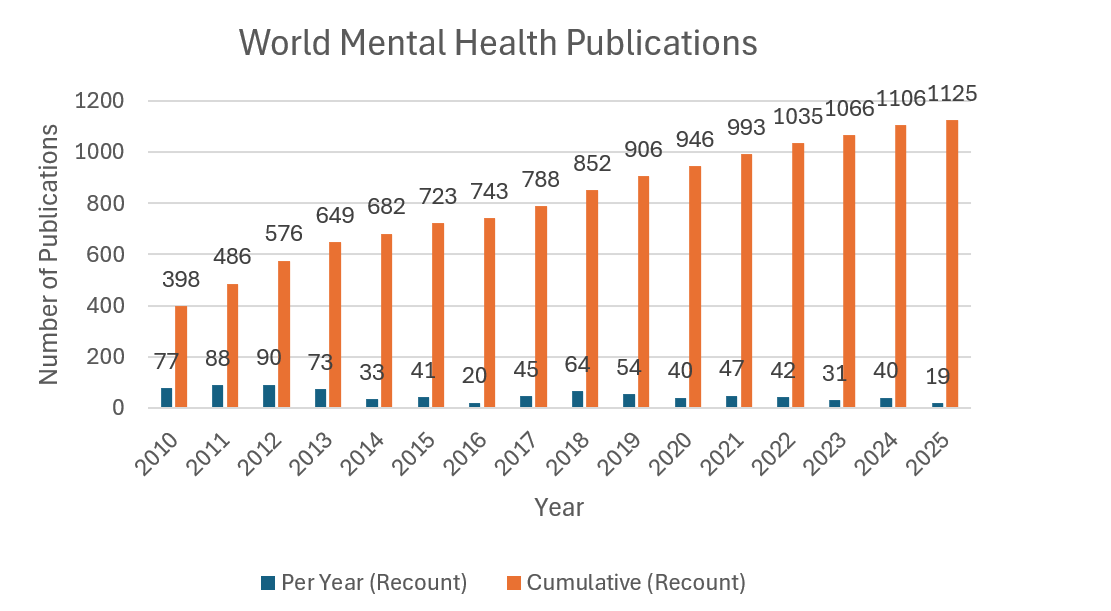
These benefits have made the carefully coordinated World Mental Health surveys among the most scientifically influential social science projects of this century. Considering the surveys collected before 2015 – using the measures and diagnoses calibrated to the DSM-IV – the data have been used for more than 1,100 publications, with more added every year (see Figure 1).
This science is a key ingredient to advancing our ability to identify:
- The true population prevalence (lifetime, 12-month, and current) of mental disorders;
- The risk factors, comorbidity, and consequences of disorders;
- The use of treatment and barriers to treatment for these illnesses; and
- The potential for interventions to minimize mental disorders.
Carefully designed to produce consistent measurement across a wide range of people, languages, and settings, the World Mental Health surveys provide a fundamental tool for discovering differences across people and place that reveal opportunities to reduce and manage mental illness worldwide. Visit the World Mental Health Survey Initiative for more details about the background of the Consortium..
The Transition to the University of Michigan
The creator of these tools and founder of the World Mental Health survey initiative – Ronald Kessler – was a University of Michigan professor in Sociology and the Survey Research Center early in his career. He moved to Harvard in 1996, collaborated with the World Health Organization to launch the first generation of WMH surveys in 2000, and directed the consortium from Harvard’s School of Public Health. Since the beginning, the global survey data collection coordination, training, and production support remained at Michigan’s Survey Research Center. Now, as Kessler retires from directing the consortium, he is passing it back to Michigan, to the new generation Co-Directors Stephanie Chardoul and William Axinn.
Axinn is the inaugural director of the new International Research Hub at the Institute for Social Research, co-director of the Chitwan Valley Family Study in Nepal, and interim director of the International Policy Center at the Ford School of Public Policy. Axinn began attending the consortium annual meetings in 2009 to integrate portions of the survey into research in Nepal. The scientific rigor and social impact of the World Mental Health surveys motivated him to become continuously more involved ever since.
The Transition will Take Time, Effort, and Support
The scope and scale of this transition is vast. Not only are we moving all current World Mental Health coordination activities to the University of Michigan, but we are expanding the scope and creating a secure data enclave to facilitate the sharing of and access to all collected WMH DSM-5 data. Five countries/regions have completed the new generation of data collection. Five more are in the process of launching and conducting data collection. Eight others are planning and fundraising to launch new data collection. These countries span every populated continent around the world.
Transitioning this work from Harvard to Michigan will not be quick, easy, or free. We welcome your support! To contact us, email Stephanie Chardoul: [email protected].
Since its inception in the early 1960s, the Social Environment and Health Program (SEH) has been a leader in the development of theory and research on the major role of psychosocial factors in the etiology and course of both mental and physical health and illness. Founded as a cross-disciplinary program, the program has been home to The Americans’ Changing Lives (ACL) study for over thirty years, which is the oldest ongoing nationally representative longitudinal study of the role of a broad range of social, psychological, and behavioral factors in health and the way health changes with age over the adult life course. Visit the ACL website for more information.
Today, SEH maintains the foundational tenet that health is socially determined by the confluence of factors at the individual, environmental, and societal level over the adult life course. We specialize in integrating knowledge from across multiple disciplines and using innovative & cutting-edge methods to characterize the social and environmental contexts in which people live their lives. Our interdisciplinary faculty includes social, environmental, psychiatric, and infectious disease epidemiologists, as well as gerontologists, climate scientists, and experts in human-centered design. Our work examines interrelated contextual exposures such as the residential neighborhood social and built environment, climate events, housing conditions, and the contexts that shape the distribution of infectious pathogens and their consequences. We do this work with particular attention to issues of health equity. We examine a broad range of health and behavioral outcomes including cognitive function, disability, musculoskeletal health, serious mental illness, sleep, and housing instability. We also interrogate the factors & processes that may link or modify the relation between the environment and these health & behavioral outcomes, including biomarkers of premature aging and housing modifications.
Cognitive Processing Therapy (CPT) and Prolonged Exposure (PE) are the most effective treatments for PTSD; however, up to 41% of patients do not improve significantly. It remains unclear how best to adapt treatment when patients show early non-response or struggle with between-session homework. To address this, our team developed the Hybrid Experimental Design (HED), a novel approach that integrates therapist-delivered and digital strategies. HED allows us to identify optimal treatment sequences for each patient. In our study (N=302), participants are randomized to CPT or PE. After 6 sessions, early responders or non-responders are further randomized to adapted treatment or maintenance strategies. Additionally, daily digital prompts are used to support homework completion. This research aims to develop more effective, efficient, and individualized PTSD treatment.
A growing literature documents Black-White inequalities in sleep deficiencies with Black adults experiencing less sleep and lower sleep quality compared to White adults. Because sleep hygiene is tightly linked to health, racial inequalities in sleep deficiencies may be a key determinant of racial inequalities in health.
Racial inequalities in work-related stress may be a crucial, but understudied driver of sleep inequalities and ultimately, health inequalities. As with all racial groups, the majority of Black men and women are in the labor force; however, compared to White adults, Black adults spend more time in the workplace, are more likely to hold multiple jobs, and twice as likely to hold two full-time jobs. Further compared to White adults, Black adults tend to be in occupations that are objectively more stressful, where they have less control and greater physical and emotional demands, and to report greater levels of stress at work.
While work-related stress has been linked to sleep deficiencies, there is a need to examine more racially-salient forms of stress such as vigilance, or the thoughts and behaviors in which Black Americans may engage in order to navigate everyday spaces such as the workplace. A substantial qualitative literature indicates that Black adults regularly anticipate and worry about potential encounters in everyday life such as being followed in stores or having assumptions made about their intellect or character. Vigilance may be particularly important for sleep inequalities because it captures a racially-salient and prevalent form of stress with characteristics that interfere with sleep quality and duration, including: (a) anticipatory stress, which predicts increased biological stress even in the absence of a stressful event; and (b) ruminative stress, which can transform acute situations into chronic sources of stress.
Using both real world and laboratory settings, we are collecting data from 500 Black men and women to capture both momentary work-related stressful experiences and chronic work-related stress. We are examining the linkages between racially-salient, work-related stress, captured through ecological momentary assessments, and sleep deficiencies, captured through self-report and actigraphy. The workplace is particularly relevant for racial inequalities in health due to focus on economic upward mobility among Black Americans and the growth of diversity, equity, and inclusion initiatives that may widen inequalities due to the need for vigilance as Black workers join predominantly White workplaces.
The overall purpose of this research program is to understand how stress and social contexts affect health and the biopsychosocial factors that account for those links. We seek to foster a multidisciplinary collaboration that capitalizes on advances in mobile technology and biopsychosocial methods to gain better understanding of social, psychological and biological factors influencing healthy aging.
Army Study To Assess Risk and Resilience in Servicemembers (STARRS) is the largest study of mental health risk and resilience ever conducted among military personnel. Army STARRS investigators looked for factors that help protect a Soldier’s mental health and factors that put a Soldier’s mental health at risk. Army STARRS ran from July 2009 through June 2015. During that time, research findings were reported to senior Army leadership as the findings became available so the Army had the ability to apply them to ongoing health promotion, risk reduction, and suicide prevention efforts. The goal of extended to contact and reinterview the Army STARRS participants from the All Army Study (AAS), New Soldier Study (NSS), and Pre-Post Deployment Study (PPDS) components of the initial Army STARRS project. In addition to collecting primary survey data for these respondents, Michigan will continue to operate and support users of the Army STARRS Research Data Enclave, which contains the Historical Administrative Data System (HADS) as well as de-identified Army STARRS primary data and Army/DoD data for consenting soldiers.
Monitoring the Future (MTF) study is an ongoing epidemiological and etiological research and reporting project that began in 1975. In addition to being a basic research study, MTF has become one of the nation’s most relied upon sources of information on emerging trends in illicit drug, alcohol, and tobacco use among American adolescents, college students, and young and middle-aged adults. Nationally representative samples of 8th-, 10th-, and 12th-grade students (about 16,000 in 140 schools per year per grade) will be surveyed annually from 2013 to 2017. A companion study continues mail follow-up surveys of high school graduates at modal ages 19-30, 35, 40, 45, 50, and now 55. The study’s cohort-sequential longitudinal design permits the measurement and differentiation of three types of change: age (developmental), period (historical), and cohort. The study allows examination the importance of many hypothesis on psychological, behavioral, and social determinants of drug use (including attitudes and beliefs, counter-advertising, role-modeling, and access), as well as a range of potential consequences (including physical and psychological health, status attainment, role performance, and drug abuse and dependence).
Lizbeth ‘Libby’ Benson, PhD, is a Research Assistant Professor in the Data Science for Dynamic Intervention Decision Making Center (d3c) at the University of Michigan’s Survey Research Center and Institute for Social Research. Before moving to Michigan, Libby completed a Postdoctoral Fellowship at the TSET Health Promotion Research Center within the NCI-designated Stephenson Cancer Center and University of Oklahoma Health Sciences Center. She received her PhD from the Pennsylvania State University in the department of Human Development and Family Studies and her BA in Psychology from the University of Wisconsin-Madison.
Libby’s research program is focused on intensive longitudinal, computational, and machine learning methods for examining temporal dynamics of affective, social and health behavior experiences using ecological momentary assessment and sensor-based data collected from individuals in their daily lives. Her goals are to understand how behavioral processes unfold across multiple time-scales and contexts, and how this knowledge can be used to build personalized interventions to facilitate health behavior change. Data visualization is also an important component of her work as a way to better understand complex behavioral processes, to generate new ideas, and to use as a tool for scientific communication. Currently, Libby is writing a NIH K01 focused on developing a reinforcement learning algorithm for personalizing intervention content in a smoking cessation just-in-time adaptive intervention.
Marilyn Sinkewicz is a health disparities researcher who examines the social, economic and historical causes and consequences of mental health conditions. Previously she was Director of Research at the New York City Department of Health and Mental Hygiene, and the University of Chicago Health Lab. She consults with local governments and communities about public health and public safety.
Dr. Sinkewicz completed her PhD and MS at Columbia University. She was a post doctoral fellow in the NIMH Psychiatric Epidemiology Training Program and in the Robert Wood Johnson Health and Society Scholars Program.
David M. Fresco is Professor of Psychiatry and Faculty Affiliate at the Institute for Social Research (ISR). His program of research adopts an affective neuroscience perspective to conduct basic, translational, and treatment studies of anxiety and mood disorders, particularly distress disorders (e.g., major depressive disorder, generalized anxiety disorder, and post-traumatic stress disorder) incorporating methodologies including functional neuroimaging (fMRI & EEG), peripheral psychophysiology, and serum markers (e.g., inflammation, neurodegeneration).
Another facet of Dr. Fresco’s research has focused on the development of treatments informed by affective and contemplative neuroscience findings that incorporate mindfulness meditation and other practices derived from Buddhist mental training exercises.
Increasingly, with collaborators at ISR, Dr. Fresco has initiated clinical trials for treatment optimization and implementation utilizing adaptive intervention methodology (e.g., sequential multiple assignment randomized trials [SMART] & just-in-time adaptive interventions [JITAIs])
Much of his current and recent NIH-funded research has focused on examining neurobehavioral mechanisms and efficacy of mindfulness-enriched treatments for chronic illnesses, and the role of emotion regulation strategies in everyday life to reduce distress.